(These are the opening remarks I gave at ‘Marxism in Motion: The Intellectual History of Marxism in and about the Global South during the early Twentieth Century’, a workshop at UCL on Friday 22nd September organised by Peter Morgan and Tanroop Sandhu.)
Good morning and welcome, everybody, and before I start I would like to extend my thanks to the organisers for the invitation to speak on some of the broad themes of what is set to be a fascinating and important workshop today. By way of introduction, I should say that there are three strands of my research which tie into today’s areas of inquiry: first, the various political manifestations of Marxism in Mexico; second, the growth of diverse and shifting radical networks in North America and the Caribbean in the pre-war period, comprising labour, cultural, and political figures and organisations; and third, the dynamic between socialist and indigenous political identities. As you can imagine, then, I was very excited to see the programme that Pete and Tanroop have put together and to hear what you all have to say. What we will hear about, I think, is heterodoxy in a time of supposed orthodoxy. This won’t be a surprise to any of you, but one still finds traces – more than traces, actually – of the received wisdom that Marxism came late to the Global South, and was imposed from without. From critics, who derided Marxism as an ‘exotic doctrine’, this was often an effective narrative to perpetuate; for so-called ‘second world’ powers with international ambitions – first the Soviet Union, later China and Albania, and arguably Cuba, though I think the latter fits into a different category – the role of saviour-from-without had some political attraction (though I must say, this usually waned fairly quickly after gruelling armed conflict – but that is rather after our period). Many histories of Marxism make reference to the Lenin-Roy ‘theses’ or debates, but the broad characterisation is that the International parked the colonial question, or fudged it. What historians of the left in the Global South recognise, however, is that these debates were not parked – they were vibrant, lively and impactful discourses, and in many places went far beyond intellectual struggle and into the temporal realm.
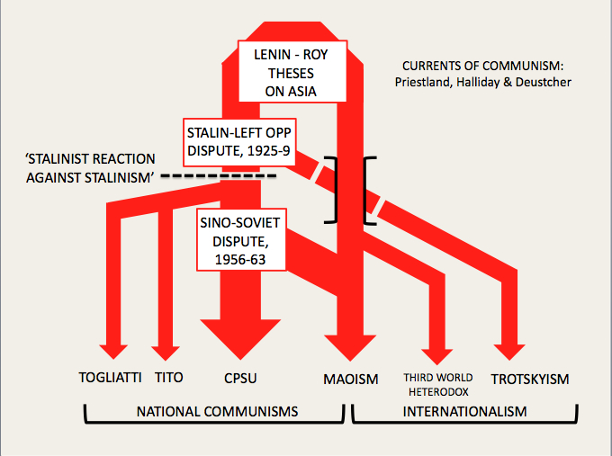
Among the papers we will hear today, there are many foci: Marxism’s interactions with other ideological and religious traditions; national and colonial questions; Marxism and feminism; and challenges to Eurocentric models of capital-labour dynamics, inter alia. Incidentally, fitting these interactions into some sort of schematic was something I dabbled with (admittedly in a rather unsophisticated way) during my doctoral research almost fifteen years ago.
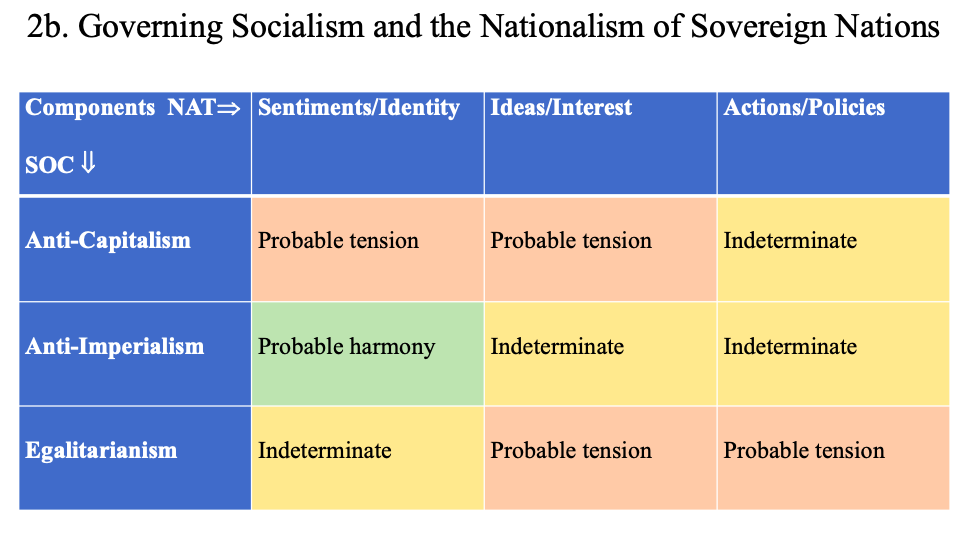
This is a diagram I made at the time – I don’t think it would be nearly as simple if I revisited it now, and I was still sticking to a simple one-dimensional continuum of nationalism and internationalism, which I don’t think holds up, but I thought you might be interested!
I think we can bring these together in three categories which of course spill out far beyond the confines of our discussions today.
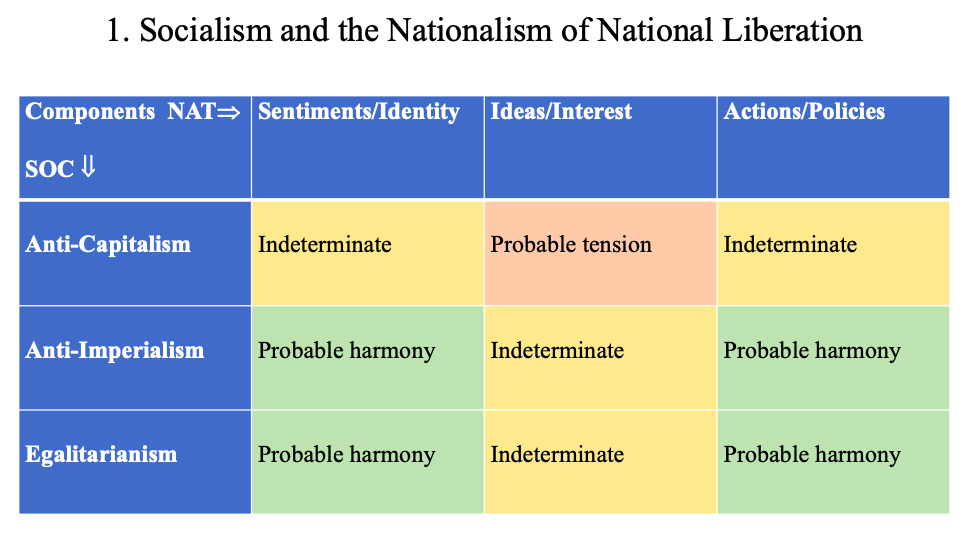
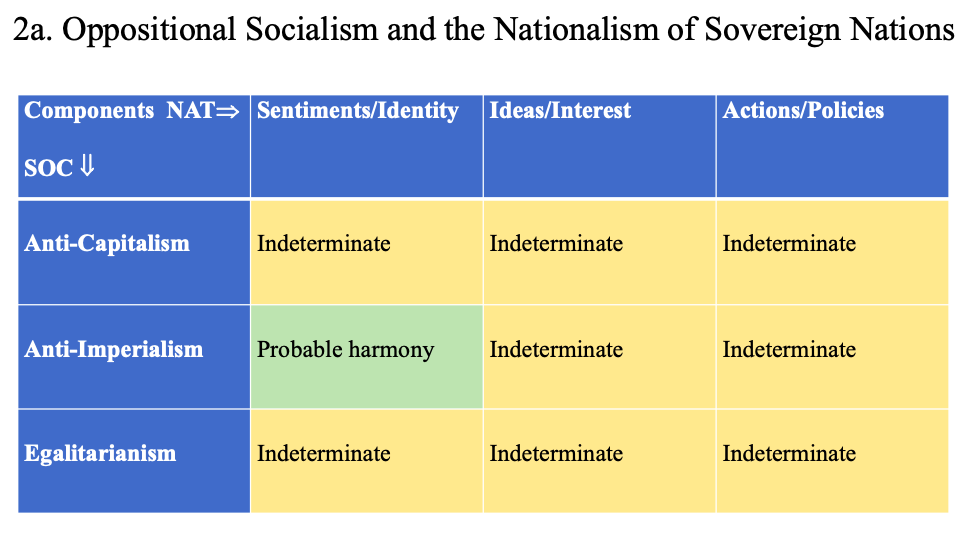
The first is state forms, which pervades discussion of Marxism as it relates to nations, empires, and colonies. State forms are dynamic across time and space, and particularly in the twentieth century were a site of conflict within Marxism but also in the broad geopolitical order. I suppose the key question here for political activists in countries of the global south was balancing the risks and rewards of riding two horses at once: the pursuit of a sovereign, autonomous nation state, and the pursuit of socialist political economy. In terms of anticolonial conflict or potential conflict, the former might be characterised as a tactical approach within the broader strategic goal of achieving the latter. However, as numerous scholars, activists and Marxist thinkers have noted, the nationalist horse has very often proved faster and stronger, bullying its socialist counterpart off the track, or at least leaving it limping behind. Does a focus on state forms necessarily relegate political economy to the margins? Again, this has been something I have – perhaps unwisely – tried to schematicise in the past.
Taking Breuilly’s view (via Morris) of nationalism as comprising sentiments, ideas, and actions, and using a definition of Marxist praxis which encompasses anti-capitalism, anti-imperialism and egalitarianism, to my mind there is considerable potential overlap between socialism and movements of national liberation. Indeed this is such a common feature of twentieth century anticolonial struggles as to be rather cliched. What is also rather cliched, unfortunately, is the extent to which this potential overlap unravels upon achievement of the nation state and particularly when socialists come to govern these new entities.
I don’t want to get too bogged down in this because of course the differences between case studies depend on a vast range of factors: factionalism, alliances, ethnolinguistic composition, class structures and so forth. However, I just wanted to restate the many ways in which nationalism can turn in to a bucking bronco, to return to my horse metaphor.
A second category would be that of capital and labour forms. Many orthodox European or European-influenced Marxists adhered to a particular schematic – some would say dogmatic – model of socio-economic change. Confronted with self-evidently unfamiliar capital-labour relations in various parts of the world, these orthodoxies could lead to two outcomes: the first, an assignation of feudal status to regions, sectors, groups of people and so forth – this was frequently the case with the Mexican Communist Party, for instance; the second being quixotic attempts to speed up the anticipated social change, to make peasants think like proletarians. This latter approach is perhaps more closely associated with liberalism in Latin America at least, but such mass social engineering had appeal to many Marxists working in health, education and infrastructure too. A third approach, though, was heterodox (and by its nature rather different depending on its context): to take Marxism as a starting point, as a framework, even as a guide, but to give equal importance to local material (and even spiritual) realities. Thus where orthodoxy could either say ‘there are no proletarians here’ or (less frequently) ‘we can turn these people into proletarians’, heterodoxy worked with what it had: ‘these people have reasons to revolt, to become socialists’.
A third category is that of social forms, including the consideration of race and gender and their relationship with socialism and capitalism. Some questions of identity which are raised here also relate to state forms and capital-labour forms of course – particularly on the so-called ‘colonial question’. While much of the conventional literature sees the integration into Marxist thought of identities beyond class as process beginning only in the 1960s, we will see today that it has important antecedents in preceding periods. There are of course plenty of accounts of debates within European Marxism on the questions of women, colonies, ethnicity and so forth, but they sometimes unwittingly perpetuate the ideas that a) Europe was the only place such debates were happening or b) Europe was the most important place such debates were happening. I don’t think we will get that impression today.
To conclude my contribution, I expect the papers presented today to show Marxism as a starting point for a wide variety of contextual discourses, with groups and individuals using that ‘prompt’ to create a multiplicity of responses to local material circumstances and prevailing ideological currents. Hence my titular analogy: Marxism in the first half of the twentieth century was a vast and expanding ocean, but where it made landfall we find many and various coasts, and in these places the land and sea shaped each other in fascinating ways.
On Sunday 13th August, voters in Argentina delivered a hammer blow both to the incumbent centre left and the conservative opposition. In the presidential primary election – an important precursor to October’s presidential and legislative elections – the far right candidate Javier Milei surprised pollsters and politicians alike by taking 30% of the vote, ahead of both mainstream candidates (Patricia Bullrich, herself more neocon than neoliberal, of United for Change; and Sergio Massa of the protean Peronists). It is tempting to dismiss Milei as a joke candidate, with his obsessions for dogs, 1970s right-wing economists, dogs named after 1970s right-wing economists, tantric sex, and 1970s hairstyles. But we have been here before: Trump, written off as absurd, a flash-in-the-pan; Bolsonaro, mocked as a hiccupping, COVID-denying coup-monger; Kast, coming within a whisker of victory in Chile despite channelling the dictator Pinochet. None of these people – or the movements they represented – turned out to be funny. A Brazilian fascist seemingly tried (and failed) to assassinate Argentina’s Vice President Cristina Fernández de Kirchner; Bolsonaristas attempted to seize Brazil’s parliament by force; and the scale and effects of January 6th 2021 are still being untangled in the United States.
Yet we are told that Latin America has turned to the left, and there is some truth in that. Global media hurried to celebrate or panic over the ‘new pink tide’ in Latin America following left-of-centre victories in Mexico (2018), Argentina (2019), Bolivia (2020), Peru, Honduras and Chile (all 2021) and Brazil and Colombia (both 2022). Only last week, the grandson of former Guatemalan president Juan José Arévalo was elected president, though he will face enormous hurdles in governing (and there is a question of whether he really represents the left – an anti-corruption sentiment is clearly politically pertinent in Guatemala, but social change will require rather more). However, to speak of a singular ‘tide’ without examining different ideological and institutional traditions or contrasting local and international contexts obscures much more than it reveals. In Chile, Colombia and Brazil, just about enough of the establishment held their noses and consented to a centre-left victory to keep out the hard right. Consenting to be governed by the centre left is another matter however, and in each of those countries narrowly-elected leaders are battling hostile media environments and intransigent legislatures. In Bolivia, Luis Arce’s 2020 victory was a restoration of longstanding MAS rule after the soft coup of 2019. Peru saw the historic victory of Pedro Castillo unravel into political farce; following his arrest, the country has been wracked by repression and violence. Mexico is another story altogether: President López Obrador remains remarkably popular approaching the final year of his term, but neither his rhetoric nor his policies can be described simply as ‘leftist’.
Current left-leaning governments in Latin America face tough structural conditions too, in sharp contrast to the optimistic period known as the ‘first Pink Tide’ (roughly 2005-2014). While Lula and Chávez (among others) were very successful in using the gains of the commodity boom in that period to ameliorate poverty and inequality, that tap has – for now -run dry. If export revenues don’t rise significantly in the next two or three years, these governments will come under further pressure since they won’t be able to perform their core function of reducing poverty and inequality. Moreover with broader global economic stagnation, as with poor management of COVID, there is a strong tendency to punish incumbent governments; thus the current crop of left-wing governments are vulnerable not only in the face of their own promises, but also to wider structural factors.
While the ‘new’ far right – Kast, Bolsonaro, Milei, Verástegui in Mexico, Cubas in Paraguay, Añez in Bolivia – is relatively united and coherent, the current Latin American left is not. Lula still has extraordinary pull as a unifying figure, able to bring together democratic and authoritarian strands from across the region, but cracks have emerged over human rights, democratic practice, and environmental policy. If left-wing governments are able to remain in place for several years then we may see progress in forging regional unity on these issues, but for now, hydrocarbon policy and political pluralism are particularly sharp fractures in a heterogeneous group which includes leaders as different as Boric, Petro, Maduro and Arce. It also remains unclear whether Mexico has a (potentially transformative) future role as a Latin American power, or whether its focus will remain elsewhere.
Argentina itself is a case sui generis. The Peronist movement – represented officially by the Justicialist Party – has for the last twenty years been seen as on the centre left, under the successive leadership of Nestór Kirchner (president from 2003-07), Cristina Fernández (Nestór’s First Lady, then president from 2007-15), and Alberto Fernández (no relation, president since 2019). Yet Peronism has always been a broad (and contradictory) church. Its candidate for October’s election is the centrist finance minister Sergio Massa, while Milei himself echoes another personalist leader, Carlos Menem, who moved the Justicialist Party sharply to the right and embraced neoliberalism in the 1990s. Peronism’s ideological flexibility has been a blessing and a curse – with brutal inflation and increasing poverty, voters likely will not see Massa as a champion of the poor.
It was always premature and reductive to celebrate a ‘new Pink Tide’; it is now clear that across Latin America the momentum is with the hard right, and a combination of public anger with ossified political elites and a middle class deeply hostile to anything resembling social democracy or redistribution may usher in a dark era for the region. We are unlikely to see the domino run of coups and military dictatorships which characterised the sixties and seventies, but an elected rogues’ gallery of gun-toting, misogynistic, queerphobic, white-supremacist, extractivist climate change deniers could wreak new havoc for Latin Americans. They are organised, globally networked (via the Madrid Charter), amply funded, and extremely dangerous, seeing the brutal political violence of the Cold War as a crusade to be admired, and even revived.
I was on the radio this morning (LBC) talking about the death of seven-year-old Guatemalan girl Jakelin Caal Maquin in US border custody. The clip can be heard here.
 Dr. William A. Booth